
ABTT and BAPAM Launch Groundbreaking Guidance on Physical Health and Well-being for Backstage Theatre Workers during Panto Season
The Association of British Theatre Technicians (ABTT) and the British Association for Performing Arts Medicine (BAPAM) have unveiled a new Guidance Note at the ABTT annual Christmas Party on the 5th December, timed to coincide with panto season – an often intense and stressful period for backstage workers.
Guidance Note W101: Improving the Physical Health of Backstage Staff is the first dedicated guidance of its kind focusing on the physical health of backstage professionals in the theatre and live production sector.
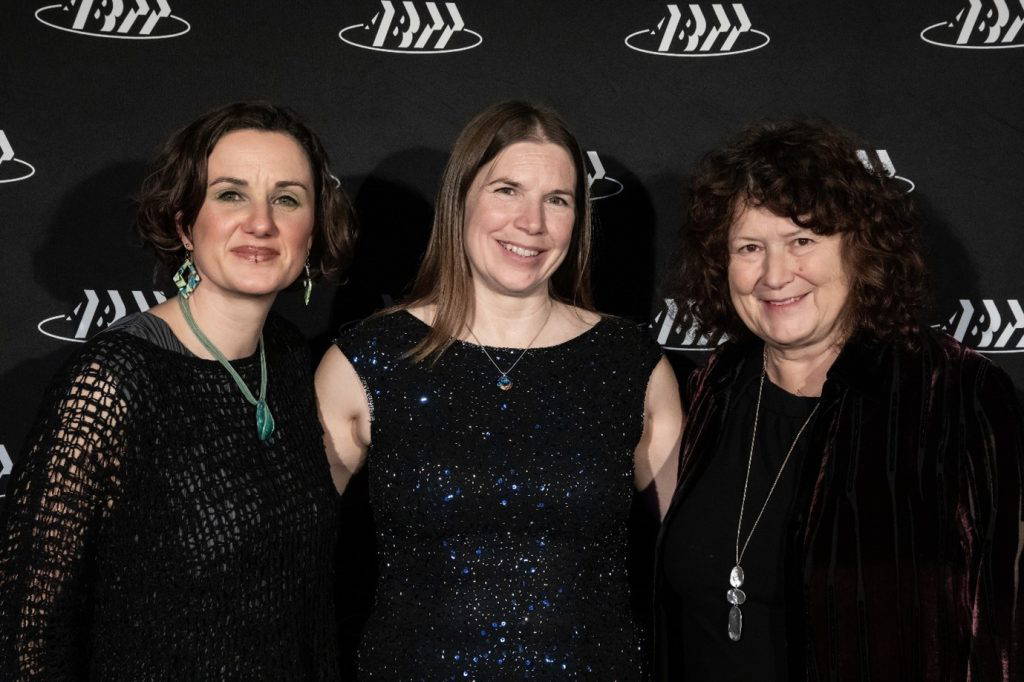
ABTT CEO, Liz Sillett (centre) with Mig Walsh, GSA (left) and Claire Cordeaux (right) at the launch of Guidance Note W101 at Gillian Lynne Theatre on Friday 5th December
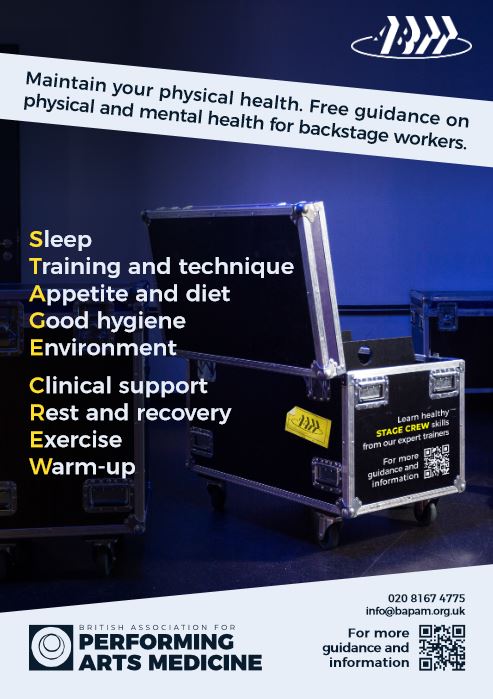
This extensive, evidence-based resource recognises the essential link between physical and mental well-being and arrives at a critical moment for the industry. Building upon the initial S.T.A.G.E. C.R.E.W. infographic, introduced at the ABTT Theatre Show in June 2024, the guidance represents a long-awaited, in-depth framework designed to improve backstage workplace health and provide practical support for theatre professionals.
Backstage professionals—including lighting, sound, stage, rigging, AV, costume and wardrobe departments and automation technicians—often work in demanding environments with long hours, heavy equipment, and limited recovery time. With more than 70% of the workforce identifying as freelance, the sector faces unique challenges when it comes to managing health and safety.
This new Physical Wellbeing Guidance Note provides detailed, practical recommendations aimed at improving physical health outcomes and reducing the risk of occupational injury or chronic illness for backstage workers.
It also includes:
- A breakdown of the S.T.A.G.E. C.R.E.W. mnemonic:
Sleep, Training & Technique, Appetite & Diet, Good Hygiene, Environment (risk assessments), Clinical Support, Rest & Recovery, Exercise & Warm-Up - Real-life case studies exploring common physical health issues
- Managerial guidance on supporting staff health
- A self-assessment tool for individual workers to evaluate and improve their wellbeing
The guidance draws on the ABTT’s deep sector expertise and BAPAM’s four decades of clinical experience in the performing arts. It is designed to be accessible, free to download, and relevant to organisations of all sizes.
The Physical Wellbeing Guidance Note will form part of the ABTT Code of Practice for the Theatre Industry in the UK, recognised by the Health and Safety Executive (HSE) as an Established Standard, and will be referenced in the Technical Standards for Places of Entertainment.
It will be made freely available via the ABTT website and integrated into the growing suite of Welfare Guidance Notes, further supporting theatre venues and employers in meeting their responsibilities under the Health and Safety at Work etc. Act 1974.
“As the largest provider of clinical services to the UK’s performing arts sector, we are proud to announce this milestone partnership with the ABTT. This is a major step forward in recognising and supporting the physical health of backstage professionals – an area long overlooked. A vibrant, healthy workforce is essential to the future of live performance.”
Claire Cordeaux, CEO, British Association for Performing Arts Medicine (BAPAM)
“The ABTT and BAPAM have worked in partnership since 2018, united by a shared commitment to improving health and welfare for the technical workforce. This new guidance is both timely and essential, providing clear, practical advice to support the wellbeing of those who bring live performance to life, and helping the industry embed healthy practices across all backstage roles”
Liz Sillett, CEO, Association of British Theatre Technicians (ABTT)
“I’m delighted to share this landmark document—the first to provide physical welfare guidance for backstage staff. My thanks to the ABTT for funding the project, to the clinicians at BAPAM for bringing it to life and to The Guildford School of Acting for supporting its development. This guidance is a vital addition to the ABTT’s technical standards and the growing series of welfare resources, helping to place health and wellbeing on equal footing with safety across our industry and I hope the sector can recognise the value of this guidance in improving health and wellbeing backstage.”
Mig Walsh, Senior Lecturer at Guildford School of Acting
Guidance Note W101: Improving the Physical Health of Backstage Staff can be downloaded on the ABTT Website for free here: Guidance Note W101
Notes for Editor:
About ABTT
The Association of British Theatre Technicians (ABTT) is a registered charity and membership organisation dedicated to raising technical standards across theatre and live performance. Founded in 1961 by a committed group of theatre technicians, the ABTT has become a trusted authority in the industry, providing expert technical advice, consultations, training, publications, and essential resources such as its Guidance Notes.
In addition to its technical leadership, the ABTT fosters collaboration and knowledge-sharing through a wide range of networking opportunities, including events, seminars, conferences, and its flagship annual ABTT Theatre Show.
Working in partnership with the National Theatre Safety Committee, the ABTT produces the Code of Practice for the Theatre Industry, which is formally recognised as an Established Standard under the Health and Safety Executive’s (HSE) Enforcement Management Model. The newly launched Guidance Note will now form part of this Code of Practice and will also be referenced in the Technical Standards for Places of Entertainment, reinforcing its role as a benchmark for health, safety, and best practice across the UK theatre sector.
For more information, please visit www.abtt.org.uk
About BAPAM
The British Association for Performing Arts Medicine (BAPAM) is the medical charity for the performing arts, working with performers and industry professionals, from musicians and singers to dancers, actors, and circus performers as well as those who work behind the scenes.
The charity provides free, bespoke sector-specific care from expert clinicians in a range of disciplines, responding to requests for help with mental health, musculoskeletal care, vocal health, hearing concerns and some eye care and dental health issues. BAPAM’s wider network of more than 300 specialists across the UK also offers support for health problems and injuries associated with work in the creative sector.
Established in 1984, BAPAM helps thousands of people each year to enjoy a healthy and sustainable career in the performing arts, and works across the sector with organisations including Help Musicians, the Musicians’ Union, Equity, PRS Members’ Fund, PPL, the Royal Society of Musicians, Actors’ Trust, Dance Professionals Fund, Equity Charitable Trust, Association of British Theatre Technicians, Healthy Conservatoires, and the Royal Variety Charity.
For more information, visit www.bapam.org.uk